
Letters To Chris
In a deeply moving piece written for the August 2024 edition of The Ironworker, Robert Letendre opens his heart to honor his beloved son, Chris, remembering his gentle spirit and his pure love for the game of lacrosse. By bravely sharing this profound loss, Robert hopes to break the silence surrounding mental health within the ironworking family. He gently reminds his fellow tradespeople that no one has to carry their burdens alone, turning his grief into a message of hope, compassion, and shared healing.
------------------------------------------------------------------------------------------------------------------------------------------------------------------------------
Pg. 1

TEN FEET TALL AND
BULLETPROOF
( NOPE, JUST A NORMAL MAN )
Hello, brothers and sisters,
I am writing this letter to you in the hope that it will help you gather the strength to seek help if necessary. My name is Robert Letendre, and I am a proud union ironworker for Local 720 in Edmonton, Alberta, Canada. I am also one of the business agents; I look after Northern Alberta. I would like to take this time to tell you about my story.
My story starts in June 2020, when COVID-19 was introduced to the world. During this time, travel was restricted, work fronts and shutdowns were postponed, and I, along with a couple of other people in the office, was temporarily laid off. I was okay with this because, as ironworkers, we always work ourselves out of a job and then move on to the next.
I decided to do some home renovations (flooring). I had a deal with my wife. When she wasn’t working, I wasn’t working. After her shift on June 9, 2020, my wife had four days off, and we decided to go to Banff to do some hiking and go on the bike legacy trail from Canmore to Banff.
On June 11, we went to Lake Louise for the Tea House hike. We did the farthest one. While on the trail, my oldest son called and asked how everything was going. He said his buddy did the same hike but then hiked to the other Tea House. We decided that if he could do it, we could too. His trek had been a few weeks before, but now the trail was covered with snow due to a recent avalanche. At the top, we realized we could not get down the other side due to the amount of snow; it wasn’t safe, and there was no trail to follow.
We had to go down the same way we went up and made it back to our vehicle about nine hours after we set out. We climbed in and headed back to our hotel in Canmore while my wife texted our youngest son about his day and work, the everyday things a kid texts his parents about.
At 7:30 p.m., he asked when we would be home the next day. We thought it was because he wanted to clean the house before we got home, like any kid might. My wife told him we would be home earlier than expected because of the long hike we had just completed, and we were scrapping the planned hike for tomorrow. He told his mom, “Suck it up, princess. You made a plan and should stick to it.” It sounded exactly like what we would have told both of our kids.
About an hour and a half to two hours later, we received a phone call from the sister-in-law asking for the code to our front door because it sounded like Chris (our youngest son) had fallen down the stairs while he was talking to his girlfriend on the phone. We gave her the code and asked her to call us back and let us know what was happening.
About 10–15 minutes later, my wife called her sister back, who told us that EMTs were working on him; that’s all we got. My wife then contacted our older son, who lived 10 minutes away and asked him to go to the house and see what was happening because it sounded like Chris had fallen down the stairs.
------------------------------------------------------------------------------------------------------------------------------------------------------------------------------
Pg. 2
Fifteen minutes later, our oldest son called us back and said his younger brother had taken his own life; EMTs were working on him and doing everything they could to bring him back. By this time, I had the vehicle loaded; we quickly fueled up and hit the highway.
At 10:30 p.m., we got the news that no parent ever wanted. Chris was gone. He died by suicide on June 11, 2020.
The drive home was the longest I have ever made. Memories, regrets, comments and his face went through my mind. I can tell you how many trucks were pulled over and how many bottles of water I drank, but I can’t remember his eulogy.
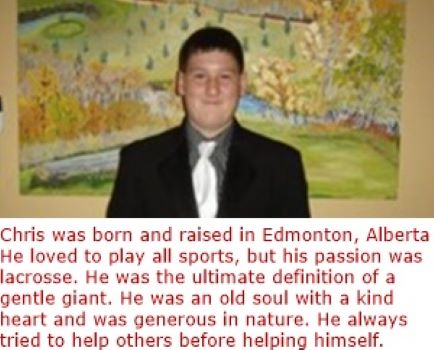
A few things about Chris: He was a big boy, 6 foot 4 inches, over 300 pounds and fast on his feet. When you saw him walking toward you, he was intimidating, but once you got to know him, you knew he was a big teddy bear. And if you were his friend, he would drop everything to help you or listen if you needed someone to talk to.
He was the one who, if you needed help at 3 or 4 a.m., would pick you up or ensure people weren’t bothering you. Chris was the person who would hide his pain and suffering and would take on your pain and suffering so you wouldn’t have to. He didn’t tell anyone about his problems or anything he was going through because he didn’t want to burden anyone.
I know what you must be thinking—what a good kid he was. Still, just like a lot of things in life, Chris had his demons, which he tried to hide—sometimes he could, and sometimes he couldn’t. But I believe this time, he was getting his life back on track because, for the first time in a while, we saw the old Chris come back, and he was owning up to his mistakes.
You are probably wondering why I’m telling my story. It’s not for anyone’s sympathy but for the hope I can help prevent this pain from happening to another person or family. I have met lots of people while on my grief journey, and you would be surprised how many times I have heard, “Oh, you must have seen the signs that he was suicidal,” but as I said earlier, he was as normal as he always was, there were no signs.
Sometimes there are signs, and sometimes there are none.
I have named this “10 Feet Tall and Bulletproof, Nope, Just a Normal Man” because men, especially us in construction, have been raised and groomed not to show emotions and to keep our feelings hidden. I can truthfully say that it only works for so long; everything comes out in the end. Nothing bothers us. We can handle anything and everything. We are 10 feet tall and bulletproof. Let me tell you that is not the case. Everything comes to a head and that is when it can be dangerous for us, as we take it out on others like family members, coworkers, anyone in our lives—or we start trying to numb the pain.

----------------------------------------------------------------------------------------------------------------------------------------------------------------------------------------------------------------------- Pg. 3
When we start numbing the pain, I can tell you when you wake up the next day, it’s still there. Somedays, it’s worse than the day before. Now you’re pissed, and that one quote comes out “What have I done?” It can and does make it harder on you and your friends and family.
Back in the day, mental health or talking about someone who died by suicide was forbidden. You were considered strange, or people lied to protect the person or the family. In 2024, mental health awareness has been brought out front and center, and it’s about time we start looking after ourselves and trying to help who we can.
We ironworkers are always the first to lead by example. We set the bar regarding safety on the job, looking out for others. Now, it’s our turn to set the bar. Call your brother, sister, coworker, partner, or family and ask your biggest, simplest question: “How are you doing? No, how are you really doing?” And then listen to their answer.
If you need someone to speak with, someone will listen and help you. You will be surprised to see how many people ask you how you’re doing, but are you comfortable enough to tell them the truth? The real question is, are you willing to ask someone how they are doing and listen if they need help, get them help or be able to point them in the direction to get the help they need?
A big concern that always comes up is, “I’m not a doctor.” You don’t have to be, just be a friend and listen. If they need professional help, you can point them in the proper direction and help them get the help they need.
I would like to thank general president Eric Dean and the general executive board for making mental health and suicide awareness a priority by creating and handing out poker chips with the new national suicide and crisis number well before it was widely available in Canada.
If you or someone you know feels suicidal or needs some help, please call the national number 988 or a helpline in your local area.
Ten-foot tall and bulletproof, nope, just a normal man.
Sincerely,
Robert Letendre
Book #1291499
In recognition of Suicide Prevention Month in September, Robert Letendre shares his heartbreaking story of tragically losing his son to suicide. Through his profound grief and unimaginable pain, he courageously shares his experience in hopes of raising awareness about the importance of mental health and suicide prevention. By bringing light to the devastating impact of suicide on families and communities, he advocates for greater support, resources, and understanding for those struggling with mental health challenges. As we honor his son’s memory, let us unite in the fight against suicide, promoting hope, healing and compassion for all.